
This is the first time I’ve written in this way about a book I’ve read, so I hope you’ll be patient and understanding that my skill, or lack thereof, in writing about a book, is underdeveloped and may not be as polished as you might otherwise hope.
Nevertheless, I would like to write more about what I read, and so I must start somewhere.
If you look at the length of this post and decide you don’t want to read the whole thing, then just know that I very much recommend this book as a lens through which to view what is currently happening with the rise of Reform in the UK and how appeals to past imperial glory are being weaponised against the British populace.
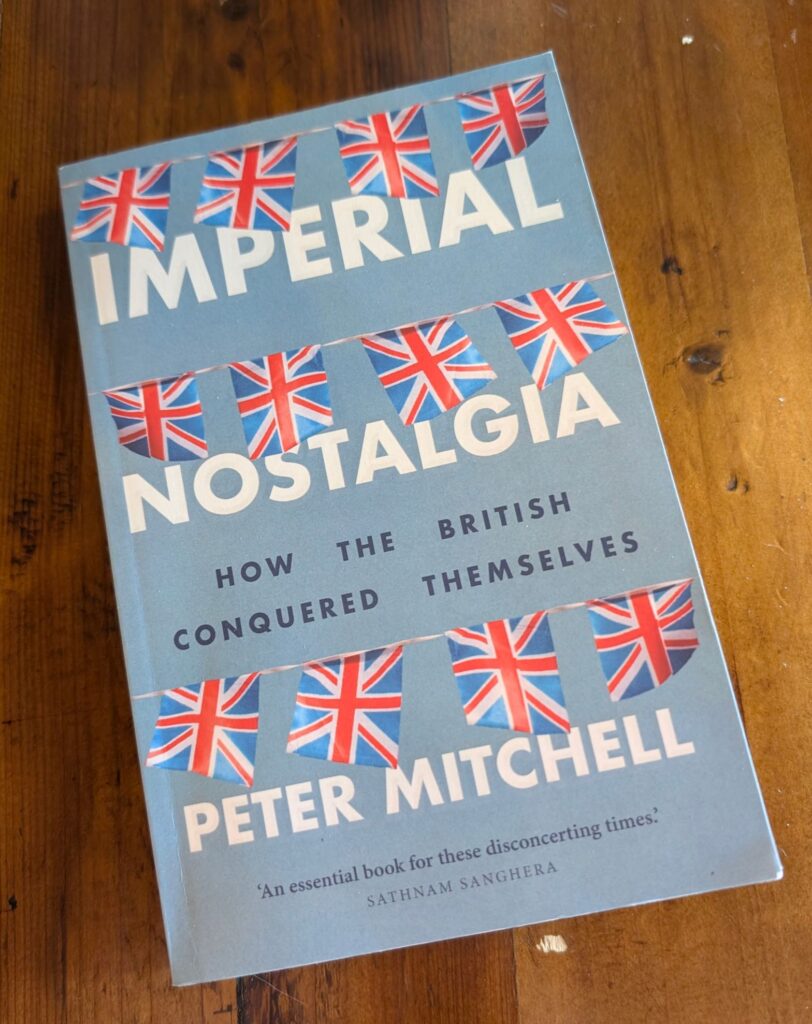
Mitchell notes at the beginning of the introduction,
This book is about Britain’s relationship to its imperial past in the second decade of the 21st century. It starts from the observation that we live in the ruins of empire, haunted by its violences and humiliations, traumatised as a society by the things we have done and had done to us in its name, and in thrall to its fantasies of cruelty, subjugation, and supremacy.
During the introduction, Mitchell describes the circumstances which led to his writing this book. He had been participating in a research project on the functioning of the British empire in the 19th century. He goes on to describe the resurgence of nostalgia used as a political weapon during the years leading up to Brexit and later during the pandemic and ensuing culture wars.
We are at time of writing in the thick of this weaponised nostalgia-baiting. Both MAGA and Reform UK have built successful political movements on this central idea that what we have now is inferior to what we had before, and that the reason for the change is some undefined other which, if only the other can be removed from society, we will once again have what we had before.
Of course, this prior state of greatness is a myth and as the book describes, it is a deliberately created and curated myth.
Chapter 1
Mitchell outlines the contrast between mourning and melancholia, an idea first put forward by Freud, where the former requires an acceptance of loss, and the latter describes an obsession with what has been lost, without acceptance. Laying these out at first, he continues to connect with the etymological definition of nostalgia, which is a sense of pain associated with one’s homeland. In short, it is the yearning for the home we have created in our minds, which is necessarily tied up with national culture and the past.
This is a convenient weapon for the right in that it leverages a blurry recollection, sanitized of wrongdoing and wrapped gently around the shoulders of national pride in the form of a flag.
On page 14, in a discussion of victor and victimhood, where he has explored how this notion of loss and obsession with the past is used to assign blame to a convenient scapegoat for that loss, with the tacit assumption that projecting a subsequent loss of security and safety on the minority reclaims an equal measure of the same to the projecting party,
There is, after all – and this is the conviction that lies at the bottom of these economies of resentment and terror – only so much safety to go round
On page 23, in a discussion of how fond remembrance of WW2 becomes a crutch during times of crisis,
We escape the trauma of the history we happen to be living through by entering the mythic time of the history we didn’t.
In a wonderful turn of phrase, on page 24, in discussing how the ultimate manifestation of nostalgia had arisen in the form of Brexit, he quotes Finlan O’Toole, who
…suggests that Brexit arose from a conflict in the post-imperial British psyche between grandiosity and abjection, expressed as an access of ‘the pleasurable self-pity in which one can feel at once horribly hard done-by and exceptionally grand.
I love the end of that sentence!
Chapter 2
Broadly speaking, not only is nostalgia of empire used in present day to create an anchor that attaches us to, and frames the current difficulties in terms of, a sanitized past, but that the creation of what empire was during the height of its success was achieved by the same means.
It’s perhaps not a surprise that the benefits of the empire were not equally distributed among the British populace. In fact at times the expenditure was deeply unpopular. To remedy this, the imperial project had to be sold to a doubtful people. Central to the perception of this project as a worthwhile endeavour to the British people was the framing of race, and specifically of white people as the superior race, as being central to the role, value and destiny that the British empire played on a historical scale. Not only was it profitable to violently oppress other races, it was presented as the only moral choice of the oppressor.
The late 1800s saw the burgeoning of the trappings of what we see clearly as Victorian culture – museums, cultural artifacts, and so on, were expanded and presented in such a way that the empire was not just the result of British adventuring and economic exploitation, but that it was an inevitable evolution of social structure, wherein the British (read: white) people brought order to a chaotic world.
All over, the British in this endeavour saw themselves as good-natured and doing it for the best of the people they encountered, and on page 57:
One of the primary tropes of imperial nostalgia is innocence, an odd conviction that, uniquely among nations, we didn’t know what we were doing but can trust that our motives were pure
Chapter 3
The bulk of this chapter concerns itself with recent (i.e. 2010 onwards) attacks on “wokeness”. The toppling of statues in the UK and the absurd response. The National Trust highlighting the racial violence that enabled the wealth that produced such idylls. The RNLI teaching Muslim women to swim in Bangladesh and the ham-fisted conservative political leveraging of press on these subjects to further their thinly concealed power-grabs.
Immigration features strongly – the channel boats and how they were characterized as a violation of sovereignty and a threat of replacement. There are links drawn between the UK and other Anglophone nations, commentary on how Australia has been held up as a model of the “right” way to police racial purity through immigration controls.
On Page 80, speaking on the role of the National Trust in British life, Patrick Wright,
traced its history as a kind of ethereal holding company for the dead spirit of the nation, a receptacle for some of the most mythic imaginings of the national relationship between place and identity.
Then, on page 93, when discussing Australia in the British popular imagination, it is seen as
a place that’s still white in the right way, which is to say Anglo, beerily masculinist, and not inclined to share. It’s barbecued meat, the fat of the land, 1950s bungalows, cheerfully uncomplicated (and unambiguously hetero) sexuality and a healthy preference for sports, all built on a solid no-nonsense foundation of genocide
Chapter 4
This chapter begins with a consideration of the role universities play in the fomentation (or not) of cultural conflict and battlegrounds of discourse and how this role has featured prominently in public discussion in recent years.
Oxford is particularly a place that not only props up but defines what empire is, who administers it, how it is administered and why. It defines a broad sense of whiteness in its historically male graduates, where gender and race are abstractions apart from the norm and something to be managed by the men turned out from the institution.
As well as the subjects taught – particularly classics – it is the sense of political and ruling-class entitlement that it instills in its students that is perhaps most regressive and anti-progress. When governments talk about Oxbridge admissions policies, they are really talking about political elite admission and membership.
The chapter continues with some exploration of the likes of Prof. Rev. Biggar, who has become the public face of the anti-cancel culture of the left and the an imperial apologist. He seems himself as a free-speech martyr, but, let’s be blunt, is mostly whining that his ill-defended positions on race, gender and class are not warmly welcomed by the academic masses.
Chapter 5
In which there is a detailed painting of the so-called “Imperial Wonder Boy”, a type of highly educated, adventurous elite man (think T.E. Lawrence), who views the empire, and the world, as a king of nature reserve for the soul. It is there to be used, to augment the adventurer’s life. My notes are scant here, so I cannot really do it justice without re-reading the chapter, which for now, I don’t want to do.
Chapter 6
We turn from abstract cultural memory to the politics of imperial memory in contemporary Britain. Political actors invoke a simplified vision of imperial confidence, global reach, and civilizational purpose to frame present-day debates about sovereignty, decline, and Britain’s role in the world. The chapter argues that this memory is rarely grounded in historical complexity; instead, it functions as a symbolic resource that reassures rather than informs.
Summary
An enlightening book on how empire both created its own nostalgia as it happened – through the widespread burgeoning of museums and other ways the British public could experience the far-flung reaches of the globe – which is to say in a peculiarly curated way, which further, is the way that the university elites and the ruling class saw fit to define it. This curation has the effect of, excuse the tired phrasing, whitewashing and justifying the suppression and violence done against the colonised.
The insidiousness of this is that, even though the “science” upon which much of this was based has since been discredited (i.e. scientific racism), the residual artifacts persisted even 100-125 years on the parochial attitude of Brits to the world at large and of one class to another in the UK itself.
The book is an interesting deconstruction of the creation of these lenses through which Brits saw themselves while empire flourished and further, how they saw themselves through the changes of the 20th century. The foggy sense of nostalgia engendered by the glorious past is now being used to justify regressive politics in the thinly veiled, but ultimately impossible, hope of recovering a sense of power and pride that was only beneficial to very few at the time, and has otherwise caused untold suffering both in the UK and across the globe.
Leave a Reply